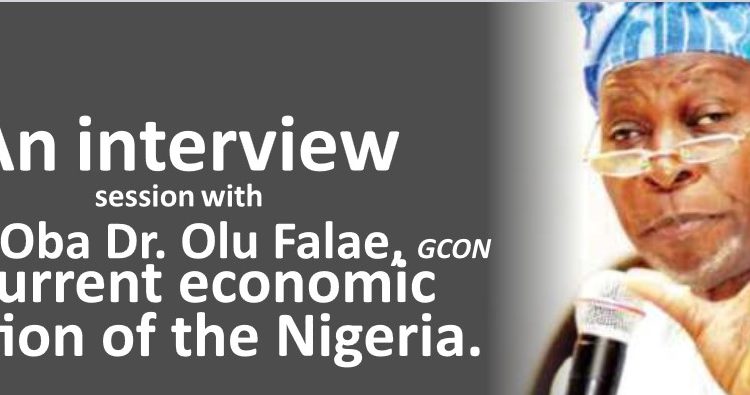
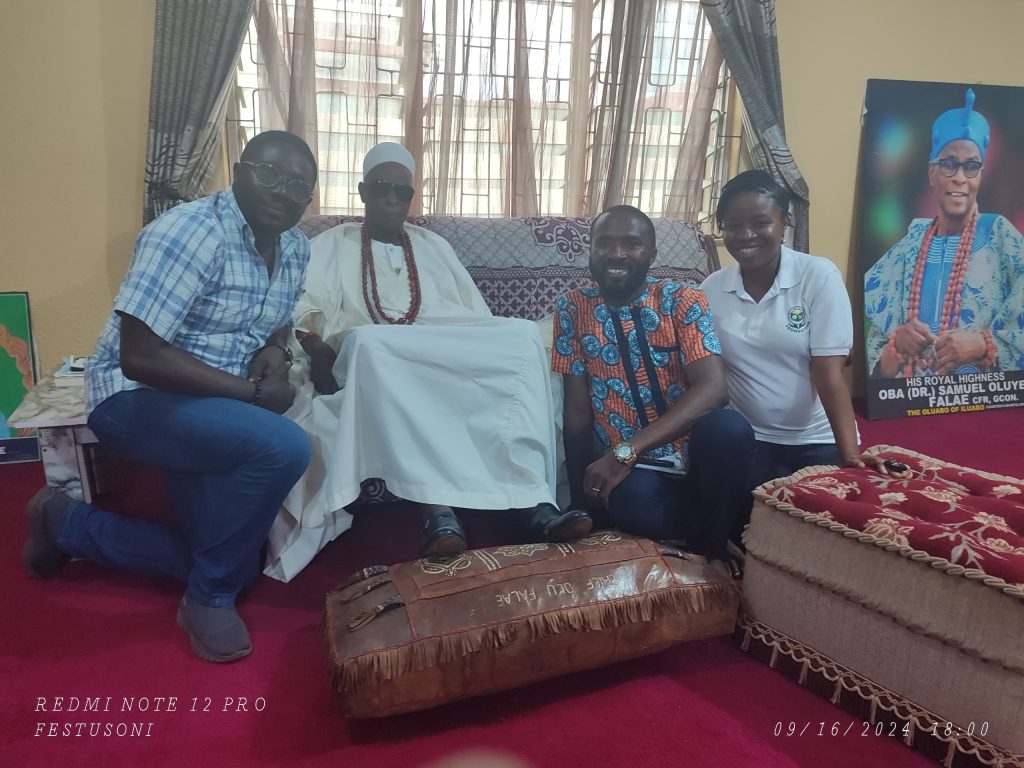
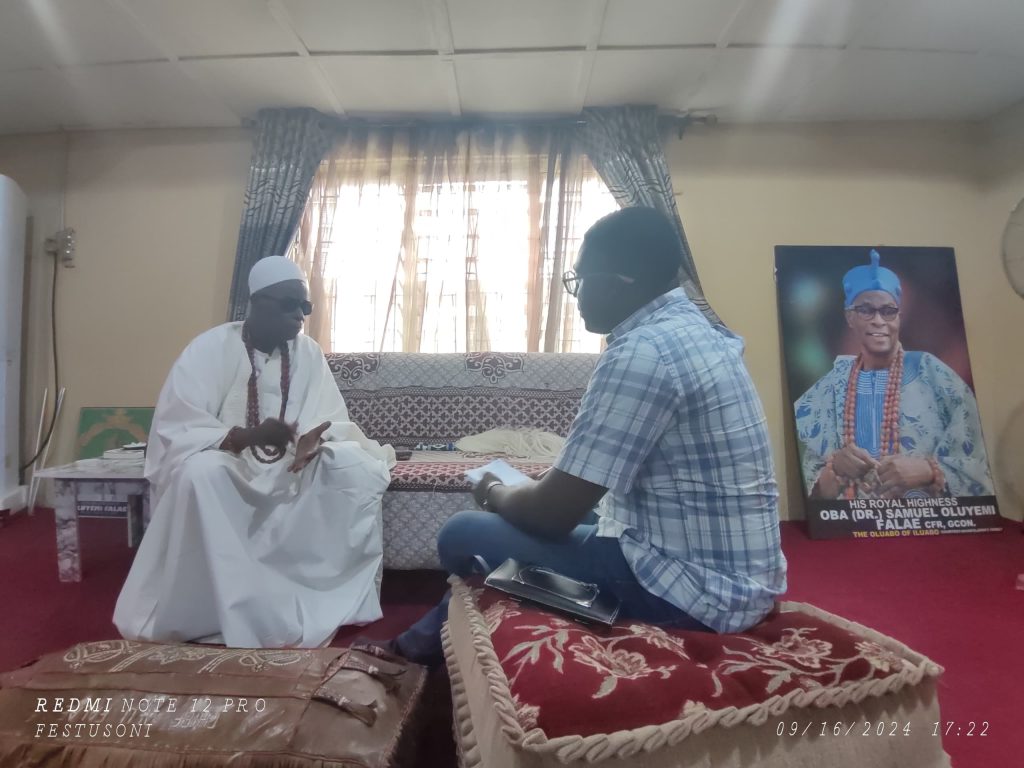
An Interview Session with HRM Oba Dr. Olu Falae GCON, On The Current Economic Situation Of Nigeria.
Interviewer: “Thank you, Baba Falae, for agreeing to this interview. Can you tell us a bit about your early life and how you got started in your career?”
Baba Falae: “My advice to all who don’t know me or want to know me is to wait for my autobiography, by God’s grace, coming out this December. I was born in 1938 in Odo Egure Village. My father was the first Baale of this land; he came to farm here in 1942. I was named after my father’s teacher, Mr. Oluyemi. In January 1944, when I was 5 years and 3 months old, my father took me to St. Stephen’s Primary School in Ijomu to start my primary education. I failed the standard test for maturity (using my right hand to touch my left ear), but my father insisted that I continue with my education. After many arguments concerning my age and height, I was admitted into Primary 1B in January 1944. Two years after I entered school, my mother died during childbirth. In 1952, I was in Standard 6 at St. David’s Primary School, where I passed the entrance exam into Government College Ibadan. The principal, Mr. Alfred Long, personally came to interview me and promised that if I passed, I would be invited to Ibadan, but I never received the letter of invitation. Instead, I went to Igbobi College.
Interviewer: “You were active in politics and served as the secretary to the Federal Government. How were you able to combine Christianity and politics? And is politics really evil or sinful?”
Baba Falae: “I presented a lecture at the Anglican Clergy Conference many years ago in Ibadan concerning Anglican clergy and politics, for which I prepared a paper. Let’s start with the Bible: when the children of Israel journeyed from Egypt through the desert to Canaan, they were led by Moses, who was a theocrat. Theocracy is governance by God. A theocracy combines all the functions of God—the political, the judicial, and the administrative. He was the lawgiver and the judge. His father-in-law Jethro visited and advised him that he could not judge the people alone, suggesting that he choose delegates to handle smaller cases in court. Moses appointed Aaron and his descendants to take care of the religious aspects of governance.
“You will recall that the children of Israel requested a king. Initially, everything was an integrated role: the priestly role was given to Aaron and his descendants, while the political component was given to Saul. Thereafter, the kingly and priestly roles were taken away from the theocratic. What I’m saying is that God has approved governance through Moses, Aaron, and the King of Israel, and governance was established by divine decree. So, my point is that God has approved governance and the means of attaining governance, which is politics, because, as far as I’m concerned, politics is the means of attaining power.
“I have no doubt whatsoever that God approved of it. When I was running for president, I stated on more than one occasion that I have never taken a bribe because:
- It was against my religious teachings.
- My grandmother, who raised me, taught me not to take what is not mine.
- I regard stealing as self-devaluation.
“I had no difficulty because the Lord did not allow the thought of stealing to enter my mind; it is an impossibility. All grace and thanks to the Lord. I was outspoken, so it was not difficult to maintain my Christian principles. I ran a bank for five years as the managing director of Nigerian Merchant Bank. I became federal secretary at 38 and retired at the age of 42, becoming the MD of Nigerian Merchant Bank the following year. I was there for five years, and I thank God because that bank doubled its profit every year during my tenure. There was not a single instance of fraud; the Lord did not let me find it difficult at all as a Christian in the way I ran my life.
“Even though this place is worse than the civil service as an OBA, it is traditional, with its own ways of doing things. Fortunately for me, when my father and others founded this place a century ago, they named it ‘Ago Abo Labe Oluwa.’ So this is a Christian community. Our forefathers were pagans, but when my grandfather came here, they were Christians. I encountered Christianity in this land, and I told my Chief, ‘I’m a Christian, a committed Christian, and this is a Christian community. You can worship whatever you like in your house, but as a community, we are Christians, and that’s my belief.’ I’m a member of the standing committee at the Cathedral and the Chairman of Fundraising for the Synod. Read More